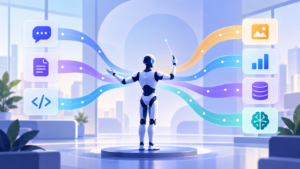
Imagine being a customer with an urgent issue: a machine has stopped working, or there’s a critical question that can’t wait. The response you receive must be quick, clear, and precise, with no room for confusion. Achieving this balance of speed, clarity, and accuracy in human customer service can be challenging, especially when requests are numerous and time is limited
With AI-powered Customer Service, this is no longer a problem. AI can analyze and learn from business data, responding in a timely, accurate, and personalized manner. Companies can now guarantee immediate responses, even in the most complex situations, without making customers wait hours or days for a solution.
The Role of Customer Service and How AI Can Enhance It
Customer service is now an essential component for every company, where providing timely and appropriate responses to customer inquiries is not just an option, but a standard that customers expect as part of the service. It is crucial for building strong and lasting relationships. Customer service goes beyond merely answering questions or solving problems; it becomes a driver of loyalty, increasing both customer satisfaction and retention.
Effectively managing customer service brings numerous benefits, including:
- Improved customer experience, leading to higher levels of satisfaction.
- Enhanced corporate reputation through quick, competent, and personalized responses.
- Operational efficiency, reducing costs by automating repetitive processes.
- Increased customer loyalty, leading to more opportunities for upselling and cross-selling.
In this context, the introduction of AI Customer Service is rapidly becoming a key strength. AI can optimize every interaction, from handling simple service tickets to addressing the most complex requests, making the service both faster and more accurate.
Degrees of AI Use in Customer Service
AI Customer Service can be implemented in various ways depending on the specific needs of the business. This is not a binary choice (AI yes or AI no), but a spectrum that ranges from minimal AI usage, with a dominant role for human interaction, to fully automated systems. Below are the different approaches businesses can adopt:
Predominantly Human Interaction
In some companies, AI Customer Service is primarily used as supplementary support. For instance, chatbots may be employed to answer frequently asked questions or collect preliminary information, but the actual customer interaction is handled exclusively by human operators.
This approach is particularly valuable in industries where empathy, personalization, or specialized expertise are crucial, such as luxury, consulting, or healthcare, where human relationships are key.
Balanced AI and Human Interaction
A more balanced approach involves AI Customer Service handling the initial stages of interactions, such as gathering information and addressing simple issues. When the situation becomes more complex or requires additional attention, human operators take over.
This model reduces the workload for operators by streamlining common requests, while still allowing for human intervention to resolve more complicated issues. It is the most common approach for businesses looking to improve efficiency without compromising service quality.
Fully Automated AI, No Human Interaction
In a fully automated system, AI Customer Service manages the entire customer service process, utilizing advanced chatbots, virtual assistants, and predictive analytics.
AI can respond to all requests, tailoring responses based on historical data and real-time information. While this approach is highly efficient and scalable, it does have its limitations.
For example, AI may struggle with complex or emotionally sensitive situations that require human interaction. Additionally, some customers may still prefer direct contact with a human operator, even if the technology proves to be more efficient.
AI Customer Service Use Cases
AI Customer Service is applied across various domains, enhancing the customer experience and streamlining business processes. Below are some real-world examples:
Chatbots and Virtual Assistants
A well-designed chatbot can do more than just answer frequently asked questions. It can guide customers through decision-making, gather feedback, and escalate requests to a human operator when needed. For example, Sephora developed a chatbot that helps customers choose the right products for their skin, improving the shopping experience.
Predictive Data Analysis
AI in Customer Service can analyze data collected during customer interactions to predict future issues and propose solutions in advance. A telecommunications company, for example, could use AI to identify patterns of dissatisfaction among customers and intervene before the problem becomes critical.
Complaint Management
AI can also play a crucial role in complaint management. It can categorize and prioritize issues, resolving less complex ones autonomously. For more sensitive or intricate problems, AI can refer the customer to a human agent with the appropriate expertise to resolve the matter.
Challenges in Implementing AI Customer Service
Despite its numerous benefits, implementing AI in customer service does present challenges. Key difficulties businesses may encounter include
Resistance to Change
Not all support teams are ready to adopt new technologies, especially if AI is perceived as a threat to jobs. It’s essential for companies to offer training and reassurance, emphasizing that AI is a complement to human workers, not a replacement.
Preference for Human Interaction
Although technology continues to advance, many customers are not yet comfortable relying entirely on AI for all their needs. Human interaction remains vital for many, especially in situations requiring empathy, understanding, or more personalized responses. This resistance to change is another challenge companies face when implementing fully automated solutions.
Integration with Existing Systems
For AI to function effectively, it must be properly integrated with existing business systems, such as CRM and ticketing platforms. Proper integration enables AI to leverage business data, ensuring a consistent and high-quality customer service experience.
Conclusion
Artificial intelligence is rapidly transforming customer service by improving operational efficiency and enhancing the customer experience. When implemented correctly, AI can optimize internal processes and create customer service that is both fast and highly personalized.
However, companies must address the challenges of AI adoption by finding a balance between automation and human intervention to maintain high-quality, human-centered service.