Over the past year, there has been growing discussion around AI agents, intelligent systems that can carry out tasks autonomously, interact with other applications, and make operational decisions without human input.
Interest is high, but so is confusion. What makes an AI agent different from a simple chatbot? How are they built? And, most importantly, what real advantages do they bring to a company that decides to adopt them?
In this article, we will explore how AI agents work, their most common use cases, the challenges they currently face, and what the future may hold.
Let’s clarify, what exactly Is an AI Agent?
An AI agent is software that uses artificial intelligence models to act autonomously within a digital environment. Unlike traditional chatbots such as ChatGPT, which mainly generate text or respond to questions, an AI agent can make decisions, plan sequences of actions, and interact with multiple tools.
For example, imagine a user asking an agent to schedule a meeting. Instead of simply confirming the request, the agent would check the calendar, verify participants’ availability, and then create the event, all without the user lifting a finger.
According to Gartner, by 2028 at least 15% of daily work decisions will be made autonomously by intelligent agents (agentic AI) (Gartner, Emerging Tech Trends Report 2024).
How Does an AI Agent Work?
Now let’s look at how an agent works and the main elements it is made of. At the core of an AI agent there are three components:
An advanced language model (LLM)
This is the “brain” of the agent. It interprets natural language requests and generates consistent responses or actions.
A system of memory and context
An agent needs to remember past information, connect data, and keep track of activities. This way, it does not restart from zero with each interaction but maintains continuity and consistency. A widely used method is the Retrieval-Augmented Generation (RAG) approach. Here, the model connects to an external database, retrieves relevant data, and integrates it into the response. This produces more accurate outputs that reflect up-to-date company information.
A set of external tools (APIs, databases, applications)
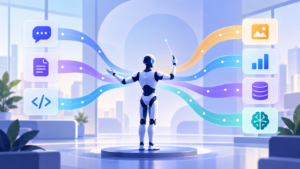
We can imagine integrations with external tools, APIs, and databases as the agent’s “arms”-they are what enable him to take real action. Without these connections he would remain isolated, while thanks to them he can interact with services such as a CRM, help desk or project management platform and perform real operations.
Today, solutions such as MCP Servers make this process even faster, allowing an agent to connect to different software in a standardized and scalable way.
The typical process works like this:
- The user submits a request in natural language
- The LLM interprets the request
- The agent decides on a sequence of actions
- It uses the available tools (APIs, databases, applications)
- It returns the result to the user, which may include a list of completed actions, a chart generated from the data, or other useful output
A crucial aspect is autonomous decision-making. The agent can decide how to reach a goal by choosing the most effective path among different options.
What are the benefits of using AI Agents?
The advantages of adopting AI agents are many. At a general level, they bring benefits that cut across organization, productivity, and user experience.
Automation of repetitive tasks
Many business processes involve simple, repetitive activities that require little creativity or expertise. Examples include updating tickets, sending periodic reports, or searching for information across multiple databases. An AI agent can handle these automatically, freeing teams from low-value work.
Constant availability
An AI agent operates 24/7. This is especially valuable in global contexts where customers expect quick responses outside normal business hours. In customer support, for instance, it can resolve the most common requests on its own and forward only complex cases to a human operator.
Scalability
AI agents allow companies to manage growing demand without adding staff at the same rate. This makes them particularly useful for fast-growing organizations or those that face seasonal peaks in activity.
How to create an AI agent
Building an AI agent is not simply a matter of connecting a language model to an interface. It requires clear design choices and a few essential steps.
Define the goal
Before writing a single line of code, clarify the purpose: should the agent support customer service, automate internal processes, or assist IT teams? Clear objectives make it possible to select the right technologies and measure results effectively.
Choose the right tools
It is no longer necessary to build an AI agent from scratch. Frameworks now exist that simplify development considerably. One of the most widely used is LangChain, an open-source library designed for creating LLM-based applications.
LangChain makes it straightforward to connect a language model to external data sources, APIs, and enterprise tools. This gives the agent the ability to retrieve information, execute actions, and maintain memory of past interactions.
As a result, it is particularly suited to building custom AI agents that go beyond generating text and instead interact dynamically with a company’s IT ecosystem.
Provide training and context
The agent must be supplied with company-specific information such as internal policies, knowledge bases, and technical documentation. The more accurate the context, the more reliable and useful the responses will be.
Monitor continuously
An AI agent cannot be left on “autopilot.” Its outputs must be monitored, errors corrected, and configurations improved on an ongoing basis.
Current Issues of AI Agents
Despite growing interest and real-world use cases, AI agents still face important limitations. Before adopting them, it is crucial to understand these challenges so that risks can be managed effectively.
Hallucinations and inaccurate responses
A common problem is hallucination, where agents generate answers that sound convincing but are factually wrong. This happens because LLMs do not truly “know” information; they predict the next word based on training data.
In a business setting, such errors can have serious consequences: giving customers incorrect answers, reporting inaccurate data, or disrupting internal processes.
Privacy and data security
AI agents collect and process large amounts of information, raising sensitive questions:
- Where is the data stored?
- Who can access it?
- Is it compliant with GDPR and other local regulations?
For many companies, the risk of exposing sensitive information to external platforms is a major barrier to adoption.
Costs of APIs and services
Building an AI agent usually requires connecting to third-party language models (such as OpenAI or Anthropic) and cloud services. These services carry costs that rise with usage volume.
Need for human oversight
AI agents do not remove the need for human supervision. Teams must still monitor outputs, correct errors, update knowledge bases, and validate the quality of responses. Without this oversight, there is a risk of depending on a system that makes decisions unchecked.
Practical applications of AI Agents
Despite their limitations, AI agents are already being applied in many fields. Real-world examples show their potential more clearly.
First level customer support
In customer service, AI agents can manage the first layer of support: answering FAQs, creating and routing tickets, or providing basic information about orders and service status. This reduces the workload for human agents, who can focus on more complex cases.
A common example is integration with help desk platforms, where the agent filters requests and prepares context for operators.
Integration with CRMs
AI agents can enrich leads by collecting information from public sources such as LinkedIn, company websites, or articles, then automatically updating the CRM with relevant details for sales teams. They can also help qualify leads by estimating the likelihood of conversion based on predefined criteria.
Internal support for IT teams
Within ITSM, AI agents can assist by diagnosing incidents, suggesting resolution steps, and guiding users through basic troubleshooting. This reduces response times and improves the overall employee experience.
Information analysis and synthesis
AI agents are valuable for knowledge management. They can scan large sets of business documents, extract key insights, and make the information quickly accessible to employees.
Other real-world examples
- Finance: verifying invoice accuracy or analyzing spending trends
- Human Resources: answering employee questions about leave, policies, or payroll
- Marketing: compiling campaign reports, aggregating data from different channels, suggesting next steps, and even generating or editing images and videos
Future Developments of AI Agents
Today’s AI agents represent only the first step in a much broader evolution. Advances in language models and AI architectures are opening new possibilities that will soon become tangible.
Improved language models (LLMs)
Models are becoming more accurate, more context-aware, and less prone to hallucinations. Forrester predicts that by 2025 we will see LLMs capable of integrating structured and unstructured sources with far fewer errors (Forrester Tech Predictions 2024).
Collaboration between agents
A key area of research is multi-agent systems, where several AI agents work together to solve complex problems. For example, an agent specialized in financial data could collaborate with one focused on customer support to design a tailored pricing strategy.
Advanced customization
Another major trend will be deeper contextualization. Future agents will be trained on company-specific data and aligned with organizational policies, tone of voice, and internal processes. This will ensure consistent, reliable behavior tailored to each business environment.
Conclusion
AI agents are one of the most significant evolutions of artificial intelligence applied to everyday work. They are not simple chatbots, but systems that can act autonomously, integrate with different tools, and deliver tangible benefits in terms of efficiency, availability, and scalability.
At the same time, they pose important challenges: hallucinations, privacy concerns, and operational costs. Turning them into a true competitive advantage requires an informed strategy and careful design.
In the coming years, with more accurate LLMs, multimodal capabilities, and collaborative agent systems, their role will expand even further. For companies, the question will no longer be whether to adopt them, but how to integrate them securely and effectively.