Every October, European Cybersecurity Month draws attention to digital risks and to the importance of prevention. Launched in 2012, the initiative involves organizations across Europe to raise awareness among citizens and companies about digital security. This year, the focus also turns to protecting work environments, where cyber threats can exploit an often underestimated element: people’s trust.
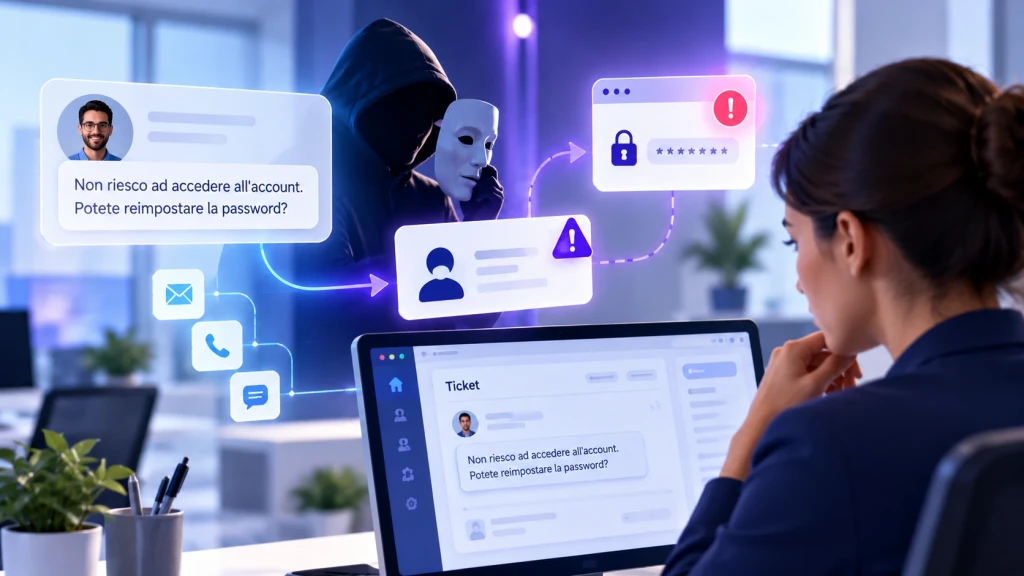
This is precisely the principle behind Social Engineering, a manipulation technique that can turn even the Service Desk into a target. Think of an employee asking to reset the password of their corporate account. The request seems ordinary, but what happens if the person making it is a cybercriminal pretending to be someone else?
You might also be interested in:
NIS2 reaches a decisive moment for Italian companies in October 2026
What Social Engineering is and how it works
Social Engineering includes psychological manipulation techniques used by cybercriminals to convince a person to take actions that compromise security. An attacker can pose as a colleague or a company manager to obtain confidential information. They often exploit situations of urgency to push the victim to act quickly, without verifying the identity of the person in front of them.
Unlike attacks that try to directly exploit a software vulnerability, Social Engineering targets human behavior. The best-known forms include phishing, which uses deceptive messages, and vishing, based on phone calls. The growing use of artificial intelligence also makes it easier to create convincing communications, increasing the difficulty of recognizing some fraud attempts.
Why the Service Desk is a target for attackers
The Service Desk handles requests related to access to company services every day. Operators may be authorized to reset passwords or act on users’ authentication methods. These activities are essential to ensure business continuity, but they can attract the attention of those seeking to gain unauthorized access. If a criminal manages to convince support that they are a legitimate employee, they could exploit a normal support procedure to compromise an account.
This is not just a theoretical risk. Google Threat Intelligence Group has documented campaigns in which attackers contacted corporate Help Desks posing as users in difficulty, with the goal of obtaining credential resets or modifying multi-factor authentication systems. In some cases, the criminals already had personal information about the victims, making their identity more credible in the eyes of the operators.
Password reset can become a security risk
Credential recovery requests are one of the most common examples of how a legitimate procedure can be exploited through Social Engineering. An attacker might claim to have lost their corporate phone and ask to change the authentication method. If the operator accepts the explanation without carrying out adequate checks, they risk giving an unauthorized person the ability to access the account.
To reduce this exposure, companies must set up identity verification procedures independent of the information provided during the request. When a user asks for a particularly sensitive change, the Service Desk should use already-registered company channels to confirm their identity. It is also important to define when additional authorization is required, especially for accounts that have elevated privileges.
How Ticket Management contributes to prevention
A Ticket Management system can play an important role in handling requests that involve sensitive data or changes to access. Logging every report makes it possible to keep a history of activities and know which operations were carried out. Through workflows configured according to company procedures, it is possible to include verification steps before authorizing certain changes, reducing the risk that a request is handled without the necessary controls.
Traceability also helps recognize anomalous situations. Multiple reset requests for the same account, for example, can be a signal worth investigating. Connecting support activities to security procedures allows IT teams to identify suspicious behavior and involve the relevant managers. The ticket thus also becomes a control tool, useful for reconstructing actions in the event of an incident.
Service Desk security starts from company procedures
Technology can support prevention, but protection from Social Engineering attacks also depends on how prepared people are. Service Desk operators must know the ways in which these fraud attempts are carried out and how to behave when faced with unusual requests. The pressure exerted by a supposed executive, for example, should never justify bypassing the verification procedures required by the company.
Automation must follow the same principles as well. A workflow that speeds up request handling can improve the efficiency of the service, as long as it maintains the controls needed for the most sensitive operations. The ability to define authorization rules and keep a history of actions helps organizations find a balance between speed of support and protection of company information.
The Service Desk plays an important role in corporate cybersecurity
Social Engineering attacks show that information security also concerns everyday support activities. A seemingly simple request can have significant consequences when it is handled without verifying who is making it. For this reason, strengthening Service Desk procedures means directly contributing to the protection of access and reducing the opportunities available to attackers.
With Deepser, requests involving access and credentials can be handled with workflows that integrate identity verification steps and authorization rules for the most sensitive operations, such as password resets or changes to authentication. Every action remains traceable, so the IT team can reconstruct what was done and recognize anomalous requests before they become a problem. Discover how we help you manage IT requests with greater control and make your support processes more secure. Request a free demo.