It’s impossible to have read the news over the past few weeks without coming across two words that keep recurring with growing frequency: digital sovereignty. It’s no coincidence that Gartner has included among the top technology trends of 2026 the concept of Geopatriation, that is, the choice to reduce dependence on suppliers outside one’s own geographic area. A direction that is already shaping the strategies of many European countries. France is accelerating the adoption of open source alternatives, Germany is investing in European platforms and infrastructure, and Italy too is moving in the same direction through initiatives such as the Strategia Cloud Italia and the Polo Strategico Nazionale, with the goal of strengthening control over data and reducing technological dependence in the most sensitive services.
This trend also involves the business world, since the technology choices of company leaders help define the degree of autonomy and resilience of their organizations. Every day we use platforms to communicate, share documents, manage processes, and store information almost without realizing it. The point is that an ever-larger share of these activities passes through a very limited number of large technology providers. When email, internal collaboration, the cloud, company data, and even artificial intelligence tools all depend on the same players, it’s natural to ask how much real freedom of choice organizations actually have left.
And if tomorrow we decided to change course, could we do it easily, or would we discover that the dependence built around these ecosystems is far deeper than we imagined?
You may also be interested in:
The CEO Perspective – Better Change Management requires operational leadership
When technology limits the freedom to choose
It is precisely in this context that many organizations face a phenomenon known as vendor lock-in. Although it is often presented as a technical issue, its impact concerns above all the freedom to independently choose one’s own digital path. If migrating to another solution requires, for example, high investments or entails significant operational risks, it’s clear that the organization has lost part of its freedom of choice. It’s a very common situation among those who use the American Big Tech companies, which have built ecosystems so extensive that pursuing alternative paths becomes increasingly difficult and costly. A problem that is further amplified in light of recent market changes, as many companies continue to depend on non-European providers even when valid alternatives developed on the continent are available.
And while in the past this dependence mainly concerned software and infrastructure, today, with the rapid spread of artificial intelligence, it also extends to the models, the data, and the platforms that fuel its development.
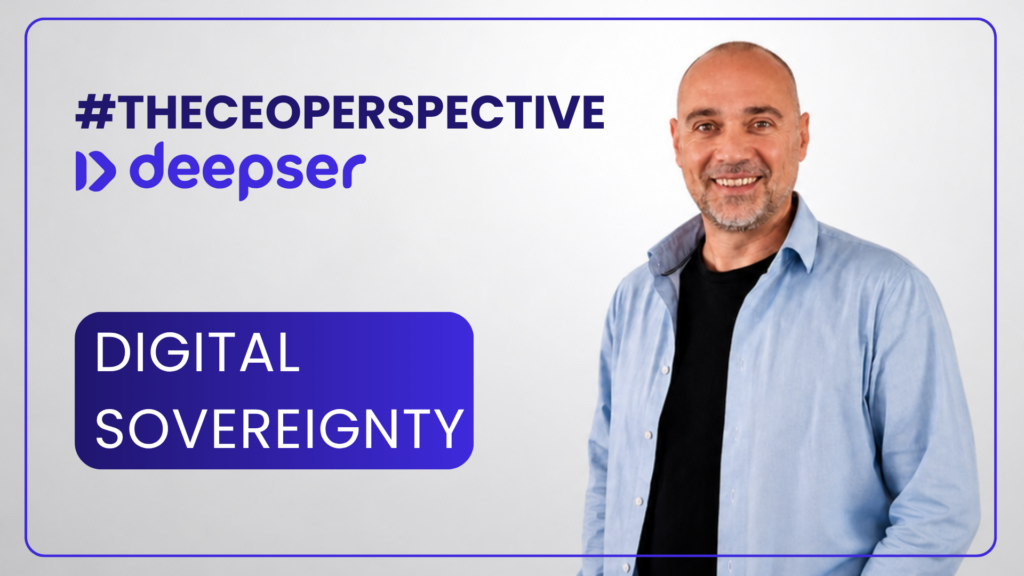
As CEO of Deepser, the first 100% Italian Service Management software, and observing every day the evolution of our native artificial intelligence, I’m convinced that the real challenge for companies will be adopting AI without giving up their autonomy. Because digital sovereignty, ultimately, is the ability to keep control of one’s own technological choices and, in my view, true innovation is the kind that expands the possibilities of choice, not the kind that reduces them.

Deepser is the only 100% Italian Service Management platform, trusted by more than 350,000 active users and designed to optimize business processes across the organization. Try our free demo and discover how we can support your company.