Imagine an ordinary morning. By 9 a.m., there are already dozens of open tickets. Many concern the same three issues. Users may phrase them differently, but the gist is always the same. The team starts responding, sorting, asking for details, and hunting for knowledge base articles that might already offer a solution
Work moves forward, but a nagging feeling remains: we are solving the same problems over and over again, with the same steps, one by one. Every day.
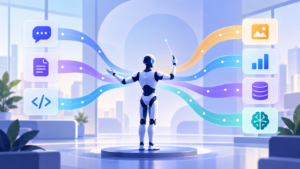
When we discuss AI Service Desks, we are not talking about adding a virtual assistant just for the sake of it. We mean using artificial intelligence to transform a system that makes operations repetitive and tiring. The goal is not to replace people, but to ensure the team’s time is spent where it is truly needed: on ambiguous cases, complex decisions, and the human relationships essential to growing the business.
What we really mean by AI Service Desk
An AI Service Desk is not a magic product; it represents a different way of delivering service. The key isn’t the algorithm itself, but where we apply it.
Practically speaking, it is a Service Desk where AI steps in when:
- A user types a request.
- The system needs to determine category, priority, routing, and sentiment.
- Relevant knowledge articles need to be identified.
- Data is analyzed to understand where the service needs improvement.
The AI reads text, consults history, and cross-references data from multiple sources—tickets, assets, services, contracts. It detects patterns that would take a human much longer to find.
It’s not just about generating sentences faster. The value lies in making operational decisions that reduce friction.
However, there is a catch: AI cannot create order out of chaos. If categorization is inconsistent, priorities are confusing, and the service catalog is full of duplicates or unclear entries, the AI will simply repeat those mistakes on a larger scale.
In other words: first you get your house in order, then you introduce AI.
This is the only way to make it work effectively and achieve results that are not just superficial, but tangible in daily ticket management.
AI Should Not Mimic the Agent, It Should Transform the System
Many AI projects begin with a fundamental misstep. They focus on questions such as, ‘How do we make the chatbot sound like a real operator?’
This path yields limited results. In these instances, the assistant provides well-formulated but vague answers, or it oversimplifies reality. It answers, but it does not assist. It fails to recognize the problem, does not classify correctly, and does not understand the context.
The result: the team still bears the full workload, but with an additional layer of complexity to manage.
The problem, therefore, is not the conversation itself, but the fact that a poorly configured AI does not impact actual workflows. Conversely, when you use it to read tickets, interpret context, and reduce repetitive decisions, the value becomes immediately apparent.
In these scenarios, the AI makes a difference because it is able to:
- Understand the nature of the request, even if the user writes in a confusing or unstructured manner.
- Propose the correct category, rather than leaving us with a pile of generic tickets.
- Recognize that a query is identical to hundreds of others already solved, and link it to the correct guide.
When these elements function correctly, the text of the response becomes almost secondary. The real impact is that the ticket flow changes. The ticket reaches the right group, with structured information and clear context regarding urgency and impact.
There is also another aspect that is rarely discussed. A good AI Service Desk helps the team decline requests more consistently. For example, when a request is out of contract or against policy, the AI can detect this, provide a rationale based on contract data, and suggest a clear but firm response to the technician. This protects the service from errors caused by haste and the desire to please everyone
How the Team’s Day Changes with an AI Service Desk
It is worth examining the practical side closely. This is where frontline workers truly feel the difference.
We often discuss average response times. In reality, the most visible benefit for the team lies elsewhere: less energy wasted on repetitive administrative tasks.
Consider a typical example. An email ticket arrives. Without AI, a human operator must:
- Read the message.
- Understand the user’s intent.
- Select a category and priority.
- Determine the correct assignment.
- Search for relevant information in the Knowledge Base.
In the long run, this has a significant impact. After handling a hundred tickets in a day, having this level of support makes the difference between a team that ends the day mentally fresh and a team that exists solely to fight emergencies.
Smarter Access to the Knowledge Base
When discussing AI in the service desk, data quality makes all the difference. The most valuable data is that which your company already possesses: internal guides, procedures, and solutions to recurring problems.
If the knowledge base is well maintained, the AI utilizes it as a reliable foundation.
It does not invent answers.
It does not rely on generic content.
It draws directly from business information through techniques such as RAG (Retrieval-Augmented Generation), and constructs responses consistent with the way your organization actually operates.
In practice, knowledge ceases to be a static repository that few people consult and becomes the operational backbone of the AI.
The more robust this knowledge is, the more reliable the AI becomes
Service Analysis: Where AI Brings Value You Do Not See Today
The aspect that many companies underestimate is the ability of AI to analyze the service continuously from a holistic perspective, understanding what is occurring beyond the individual ticket.
It is not reading a single ticket. It is reading thousands of technical narratives.
Each ticket contains clues: the application involved, location, timestamp, software version, request type, user phrasing, perceived impact, and time to resolution.
Taken individually, these details reveal little. It is when they are aggregated that meaningful signs emerge.
A well-integrated AI in the Service Desk analyzes more than just text. By correlating historical data, behaviors, and usage spikes, it can detect phenomena that would otherwise go unnoticed.
1. Recurring Service Weaknesses
- Does a software release cause a consistent increase in tickets?
- Does an external vendor create bottlenecks only at specific times?
- Does a department open an abnormal volume of requests despite training and procedures?
Taken separately, this information appears as background noise.
The AI, however, synthesizes the data and transforms it into a clear signal.
The impact on IT is immediate:
It allows the team to decide whether a technical change, a procedural review, or a discussion with the vendor is required.
2. Indirect Impacts Missed by Standard Reporting
Standard reports indicate ticket volume, resolution times, and agent activity.
However, they do not explain why a service is degrading, nor do they warn you before it happens.
AI can detect correlations between data points that rarely intersect in traditional reports:
- An increase in requests following every software release.
- Incidents that consistently involve the same combination of assets.
- A service that slows down during the same specific time window.
The AI does not invent data. It merely perceives patterns that are too subtle for a static report or a human operator to detect.AI does not invent anything. It merely sees patterns too fine for a static report or a human operator to see.
3. Predict Future Volumes More Accurately
If the administration department experiences a surge in requests every November due to fiscal closings, the AI learns this pattern.
If every update of a specific tool triggers two weeks of repetitive tickets, the AI identifies it.
In short:
Predictive capability improves because it ceases to rely on human memory and depends instead on hard data.
This facilitates shift planning, resource allocation, and the definition of SLAs that align more closely with actual service demands.
4. Provide the IT Manager with Solid Arguments for Business Discussions
When raw numbers evolve into patterns, conversations with business stakeholders cease to be matters of opinion.
There is no longer vague talk such as:
‘Department X seems to have so many problems.’
Instead, the statement becomes specific:
‘In the past three months, Department X has generated 26 percent more tickets, all related to the same service, following the new release of Platform Y.’
This type of evidence helps to:
- Justify investments in critical areas.
- Negotiate governance and SLAs with suppliers.
- Decide where to introduce new automation.
- Validate reviews of internal processes.
The AI becomes a tool for decision support, not merely an automaton.
Projects that start too big
Another risk involves beginning with overly ambitious goals: a full chatbot, automation everywhere, and processes rewritten from scratch. The result is often slow implementation and low adoption.
MIT reports a very clear figure: 95 percent of Generative AI projects in companies fail. This is not because the technology is ineffective, but because many projects start without a clear direction. AI is viewed as something to be adopted ‘because everyone else is doing it,’ rather than being anchored to a real service problem.
The best approach is to start with simple, high-volume cases, measure real results, and proceed in steps.
Conclusion
If you wish to adopt an AI Service Desk, you do not need to start with massive initiatives. All it takes is a few targeted use cases. A frequent ticket category, a consolidated knowledge base, and a clear workflow. Apply the AI there, observe how the team’s work changes, fix what does not work, and then extend the scope.
If you use a platform like Deepser, you have a distinct advantage. The AI encounters an environment that is already orderly, integrated, and consistent. The team operates within a single space. The data is standardized. Consequently, any improvement becomes visible much faster.
Do you want to see how it works in practice?
Request a free demo of Deepser and try the platform yourself.