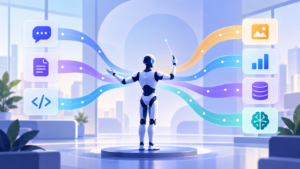
Introduction to AI Ticketing
Customer support, like many other industries, is undergoing a technological revolution with the rise of artificial intelligence. Businesses across all sectors are incorporating AI into their ticketing systems, enhancing both operational efficiency and service quality. AI is making ticketing systems smarter, enabling them to respond more quickly and accurately to customer requests.
This transformation speeds up support processes, improves accuracy, and provides more personalized experiences. By automating repetitive tasks, AI allows support teams to focus on more complex issues.
What is AI Ticketing and how it works
AI Ticketing refers to the use of artificial intelligence to enhance a ticket management system, thereby improving both the customer experience and the efficiency of support teams. In traditional systems, when a customer submits a support request via a user portal or email, a ticket is automatically created. However, the assignment to a human agent is still done manually. With AI, the assignment process can now be automated as well.
At the core of AI Ticketing is the integration of machine learning and Natural Language Processing (NLP) algorithms that analyze the content of requests. These algorithms can understand the language used by customers, enabling the system to process requests independently without manual intervention.
AI performs various tasks throughout the ticket’s lifecycle, such as automatically classifying requests, analyzing sentiment, generating responses, and monitoring performance. These features help streamline the ticketing process, enabling support teams to manage a higher volume of requests while maintaining service quality.
Automatic requests categorization
One of the major challenges for support teams is handling the large volumes of requests that arrive each day. Without an efficient system in place, technicians can quickly become overwhelmed and may struggle to address all tickets promptly. In an AI Ticketing system, artificial intelligence automatically categorizes requests, ensuring each ticket is assigned to the appropriate category or subject area.
For example, if a customer reports an issue with their network connection, the AI can identify key terms in the request (such as “connection,” “network,” or “access problem”) and automatically classify the ticket as a network-related issue.
Additionally, AI Ticketing systems can suggest ticket prioritization based on the severity of the problem, using predictive models built on historical data. This ensures that more urgent issues are addressed quickly, helping to streamline workflow management.
Requests Sentiment analysis
A key advantage of using artificial intelligence in ticketing systems is its ability to analyze the sentiment behind customer requests. Sentiment analysis involves understanding a customer’s emotions or attitude based on the language they use in their message. AI can detect whether a customer is satisfied, frustrated, or angry by analyzing their choice of words and expressions.
This feature is especially valuable for support teams, as it helps them prioritize tickets from customers who are upset or dissatisfied. For instance, a customer who uses strong negative terms (like “urgent,” “disastrous,” or “terrible”) may receive faster attention to resolve their issue quickly and maintain high customer satisfaction.
Additionally, sentiment analysis allows support teams to tailor their responses, adjusting the tone to match the customer’s mood. If the AI identifies negative sentiment, the support team can respond with a more empathetic tone, showing understanding and care.
Automatic responses
A key feature of AI Ticketing is the ability to automatically generate preconfigured responses. These responses are created based on the content of the ticket, either offering solutions or requesting additional details from the customer.
The AI can analyze the issue described in the ticket and, using its knowledge base, identify relevant answers or standard procedures. For instance, if a customer reports a connection issue, the AI might suggest troubleshooting steps.
What’s more, AI can learn from previous interactions, improving the accuracy and quality of the responses over time. This means that the system gets better at suggesting solutions as it’s used more frequently. Automatic response generation helps reduce the workload for support agents, allowing them to focus on more complex issues while maintaining high-quality support.
Beyond speeding up ticket handling, this automation ensures consistency in responses and maintains a uniform tone. For customers, this means they receive quick, accurate replies, enhancing their overall support experience.
Monitoring KPIs and team performance in AI ticketing
Another major benefit of AI Ticketing is its ability to monitor real-time Key Performance Indicators (KPIs) and track the overall performance of the support team. AI-powered systems can analyze large amounts of ticket data, including response times, resolution times, the number of open and closed tickets, the quality of responses, and customer satisfaction.
By automatically processing this data, companies can generate detailed reports and KPIs without needing manual input. The AI not only collects the data but also visualizes it in real-time, automatically creating graphs that make it easier for managers to understand.
For example, the system could produce a graph showing ticket trends over the past six months or a chart displaying average response times for each agent. These charts can be created simply by requesting information through the interface or chat, with the system providing clear and actionable visualizations right away.
Additionally, AI can predict when ticket volumes will peak or when certain team members might be overwhelmed, allowing companies to plan additional resources in advance. For instance, if the system identifies a recurring issue that peaks on certain days or times, it can automatically suggest resource adjustments to handle the increased demand.
Performance monitoring also extends to service quality. AI can evaluate customer feedback and agent responses at the end of each interaction, offering continuous feedback to help the team grow and improve. The system can even suggest actions to enhance response quality or address any process weaknesses.
AI Knowledge Base: transforming knowledge management
The integration of artificial intelligence into the Knowledge Base is transforming how information is collected, organized, and utilized in both customer and internal IT support. Traditionally, creating and updating support articles was a manual task that required significant time and resources. With AI technologies, however, AI-driven Knowledge Bases are automating and streamlining this process, offering a range of benefits. Let’s explore some of them:
Automatic creation of articles from support tickets
One of the most immediate benefits of AI in Knowledge Bases is the automatic creation of articles directly from support tickets. When a customer submits a request and the support team resolves it, AI can analyze the ticket and generate a detailed article documenting the solution.
This greatly reduces the time needed to create valuable content, as AI can automatically extract key information from a resolved issue and draft a relevant support article. In practice, AI helps gather and organize knowledge while automating documentation, creating ready-to-use resources without any manual effort.
Over time, the system builds a constantly updated archive of articles that address common issues and frequently asked questions. This makes troubleshooting faster and more efficient for both the support team and customers.
For example, if customers often report an issue with accessing an application, AI can gather all the details from those tickets, create an article explaining the solution, and automatically add it to the Knowledge Base. This reduces the likelihood of receiving repeated requests about the same issue in the future.
Knowledge Gaps Identification
Another powerful application of AI in Knowledge Bases is the ability to identify “knowledge gaps.” AI can analyze support tickets over time to spot topics or areas that are not adequately covered or documented in the Knowledge Base.
If certain inquiries frequently arise on a subject that is either not covered or insufficiently addressed, AI can suggest creating new articles or adding relevant information to fill these gaps.
This process, which would typically be handled by support staff or documentation teams, can now be automated, ensuring that the Knowledge Base is constantly updated with relevant and comprehensive content.
Continuous optimization and learning
The shift from a static Knowledge Base to an AI-driven one means that, over time, the Knowledge Base becomes more accurate, enhancing the system’s ability to predict and resolve issues without human intervention. As the content evolves, support teams can reduce the resources needed for manual updates and maintenance, as AI automatically identifies and corrects errors or inconsistencies.
Proactive support and contextual guidance
One of the most advanced uses of AI in Knowledge Bases is proactive support. In the past, when a customer submitted a request through the user portal, the system relied on string matching techniques, which compared the ticket text to predefined keywords or exact phrases. This method had limitations, as the system could only find relevant answers if the customer’s words matched the exact terms used in the Knowledge Base articles. If the customer used different terminology or described the issue in a way that didn’t match the article, the response would be irrelevant, often leading to the ticket being opened.
Now, with the integration of Retrieval-Augmented Generation (RAG) systems, the approach has become far more powerful. Instead of searching for exact keyword matches, the AI scans the entire Vector database, finding more relevant answers even when the customer’s terms differ from those in the articles. This allows the search engine to understand the context of the issue and provide more accurate, useful answers.
For example, if a customer writes, “I can’t log into my account,” and the Knowledge Base has articles about login problems using different terms like “account login,” the RAG-powered system will still recognize that it’s the same issue and suggest the right article. This way, the AI can offer a solution right away, without needing to open a new ticket.
This type of support not only reduces the number of open tickets but also enables quick resolution of common issues without human intervention. Customers get fast and accurate responses, while support teams can focus on more complex problems.
Overall benefits of AI ticketing
The integration of AI Ticketing offers numerous benefits for companies and support teams, and not just for ticket management itself. The first and most obvious positive spin-off is increased operational efficiency.
Another key advantage is the scalability of support. As a company grows and the volume of requests increases, AI allows fewer people to manage more tickets without the need to hire additional support agents. This reduces the cost per ticket and makes support more sustainable in the long run.
Conclusion
As we’ve seen, adopting AI Ticketing brings a range of benefits, not just to ticket management but to the entire support process. The most immediate benefit is a boost in operational efficiency. By automating repetitive tasks such as ticket categorization, response generation, and data analysis, companies can reduce manual workload, speed up responses, and improve service quality for customers.
Another major advantage is the scalability of support. As a company grows and request volumes increase, AI enables the team to handle more tickets without needing to hire additional support agents. This makes support more sustainable over time, reducing the cost per ticket and enhancing the company’s ability to handle peak workloads effectively.
In addition, AI improves the customer experience through faster, more relevant and personalized responses, reducing resolution time and increasing overall satisfaction.
At Deepser, we are excited about how these technologies can transform customer support. For this reason, we are implementing artificial intelligence in our product. The goal is to provide our customers with an increasingly intelligent and automated experience, enabling them to improve operational efficiency, optimize request handling, and ensure high-quality service that is always scalable and adaptable to new challenges.