For a long time, IT Service Management and IT Operations have worked as two parallel worlds. The service desk handles user requests and tickets, while operations teams look after the infrastructure and system availability. Although they work on the same services, they often rely on different tools and priorities.
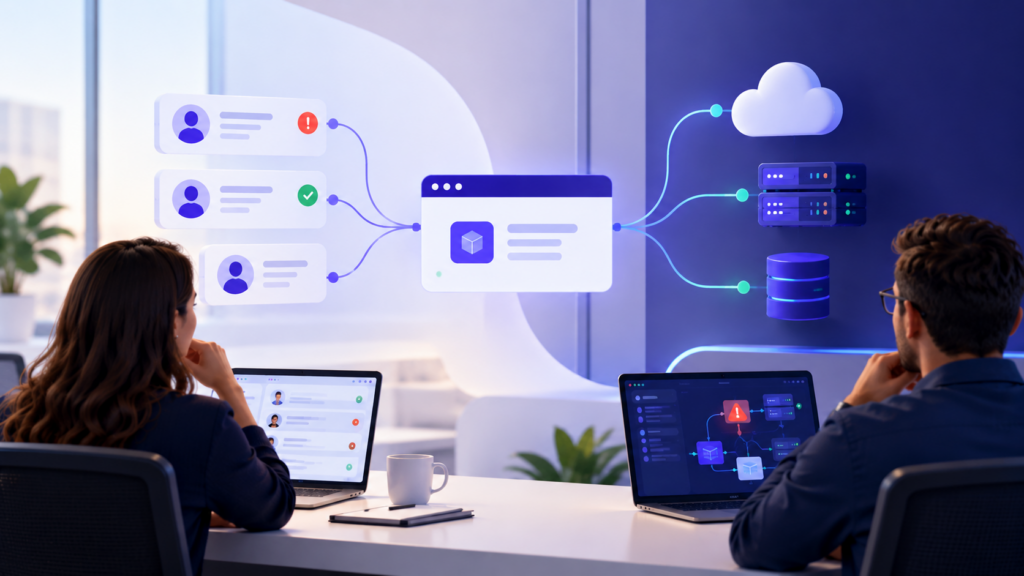
This separation becomes most visible during an outage. A system slows down, monitoring triggers an alert and, shortly after, the first user tickets start coming in. The same problem is seen from two different points of view, and each team only has part of the information. The time needed to piece it together adds to the time needed to fix the issue.
This is where the concept of ServiceOps comes from: an approach that brings service management and IT operations management into the same workflow. The goal is to make sure that whoever needs to step in has the necessary context right away, wherever the problem first appeared.
You might also be interested in:
IT Operations Management: Essential Practices for Enhanced Service Delivery
ServiceOps starts from the processes you already have
Adopting a ServiceOps approach rarely requires reorganizing IT or creating new roles.
The starting point is to look at what happens between the moment a problem is detected and the moment it is resolved. In many organizations, this gap is filled with manual steps, with information copied from one tool to another and teams waiting for updates.
Reducing these steps means letting ITSM and ITOM work from the same context, while each keeps its own responsibilities.
Silos show up most clearly during incidents
When the service desk and operations teams use separate tools, every incident requires some reconstruction work.
The service desk receives user reports but sees little of what is happening in the infrastructure. Technical teams, on the other hand, receive alerts without knowing how many users are affected.
Bringing these two perspectives together takes time, and that time weighs directly on MTTR. Part of the handling is spent figuring out what the problem is, before anyone can start solving it.
An alert becomes valuable when it is linked to the service
A CPU usage spike can be irrelevant at one moment and critical at another. It depends on which services rely on that system at that specific time.
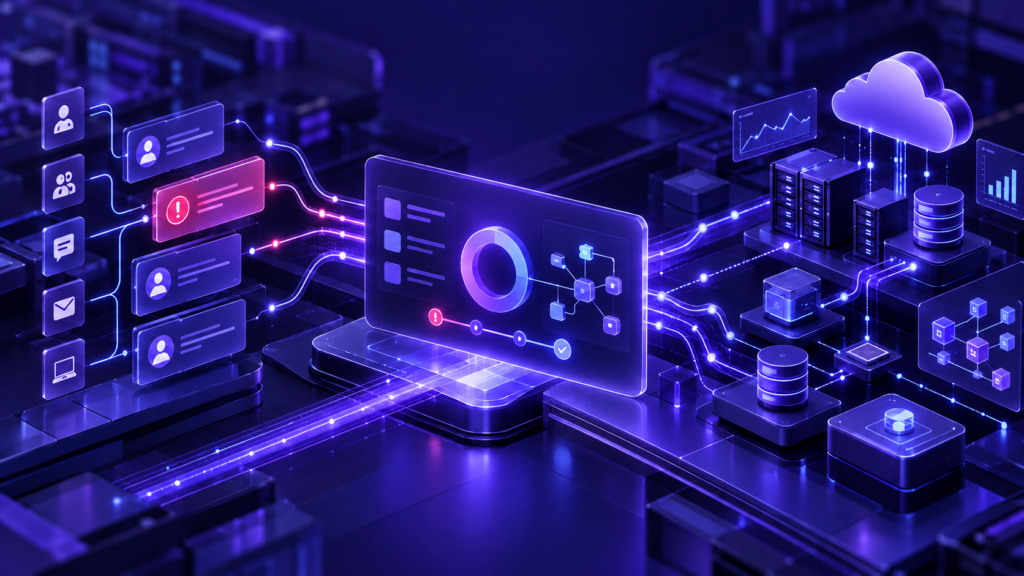
That is why one of the core aspects of ServiceOps is the ability to link technical events to their impact on the service. When monitoring events enter Service Management processes, they can be correlated with each other and become incidents only when there is a real effect on users.
As a result, the team receives fewer alerts, each one with more context.
The CMDB connects infrastructure and services
To understand which service is hit by a technical event, you need to know how the different components are connected.
This information lives in the CMDB. The relationships recorded between components make it possible to trace an anomaly back to the affected service, and from there to the users who feel its consequences.
An up-to-date CMDB becomes a shared reference for those who manage the infrastructure and those who manage the service. Both teams read the same data, each for its own purposes.
Many incidents start with a change
A good share of outages originates from a recent change.
If information about changes stays separate from operational data, finding this link requires manual checks. With a ServiceOps approach, the team can immediately check whether an anomaly coincides with a planned intervention and decide more quickly how to proceed.
It also works the other way around. Data collected from past incidents helps assess the risk of future changes more accurately.
Automation cuts down manual steps
The convergence of ITSM and IT Operations is also driven by the evolution of automation and artificial intelligence.
An incident generated by an alert can be automatically assigned to the right group, already enriched with the technical data collected by monitoring.
The time saved on sorting tasks can go into analyzing the problem, which remains the work where people’s experience makes the difference.
Two teams, one workflow
ITSM and IT Operations will keep having different responsibilities. What changes is the way they work together.
When technical signals and incidents live in the same environment, the path from problem to solution gets shorter. Technical teams see how their work affects users, while the service desk can keep the people involved updated with accurate information.
With Deepser, the service desk and operations teams work on the same platform. Alerts from monitoring systems automatically become tickets linked to the CMDB, which instantly shows which services and users are affected and helps assess the impact of a change before planning it.
Try our free demo and discover how we can support your company.