Uptime: the Deepser module for uptime monitoring of web services
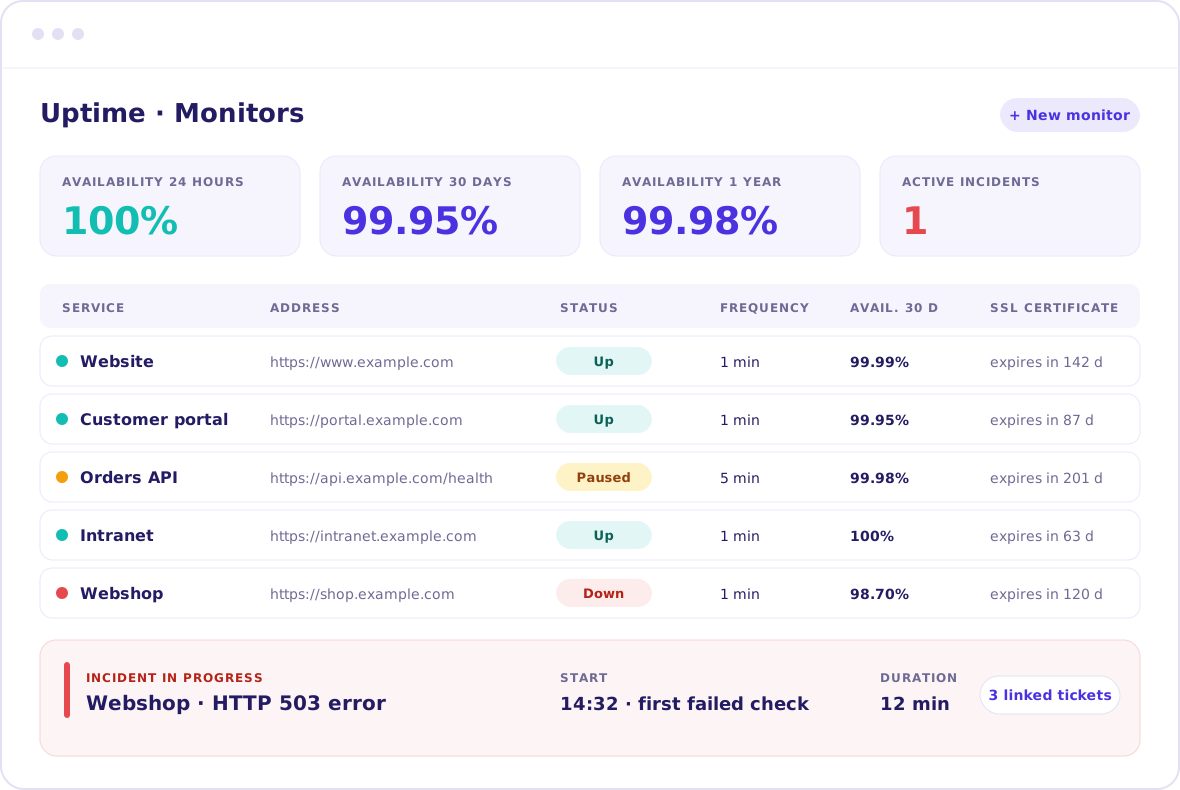
Uptime automatically checks the availability of websites, portals, applications and APIs, logs every incident, measures the downtime and links it to tickets.
Clients that trusted us





Don’t find out about downtime only from user reports
Uptime spots downtime in your services early and keeps the details needed to reconstruct the event: when it started, how long it lasted and what caused it.
Everything Uptime needs,
in one place
Checks and thresholds
HTTP/HTTPS checks at regular intervals
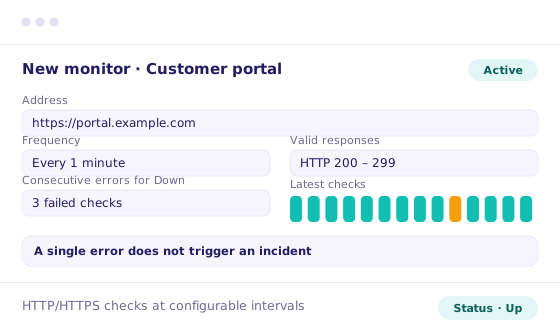
Choose how often to check, which responses mean a service is healthy and how many failed checks confirm an incident. That way you ignore brief slowdowns.
Minimum check interval: 1 minute
Configurable expected responses
Consecutive error threshold
Fewer false alarms
History and availability
Every minute of downtime is recorded
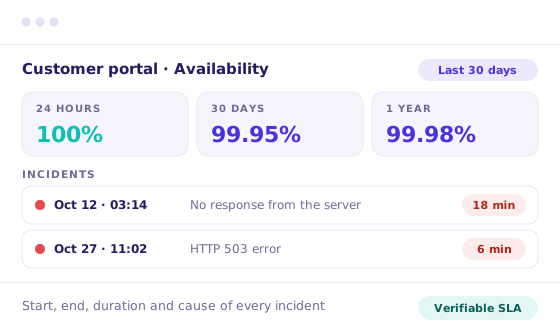
Every incident has a start, end, duration and cause. Availability is calculated over 24 hours, 30 days and one year: you check SLAs against real data, not estimates.
Start, end, duration and cause
Duration updated in real time
Availability (uptime) 24 h, 30 d, 1 year
Verifiable SLAs
Maintenance
Planned maintenance doesn’t skew the numbers
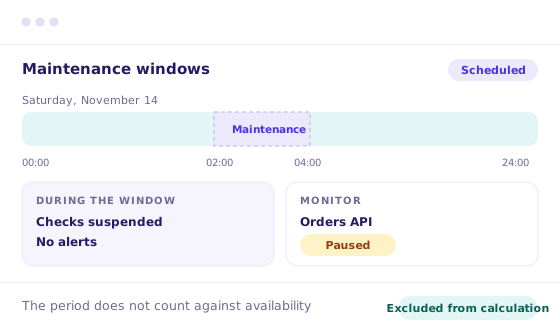
Schedule maintenance windows: checks are suspended and that period is excluded from availability. You can also pause a single monitor, for example during a migration.
Maintenance windows
Pause per monitor
Availability unaffected
Checks suspended
Tickets and Flow
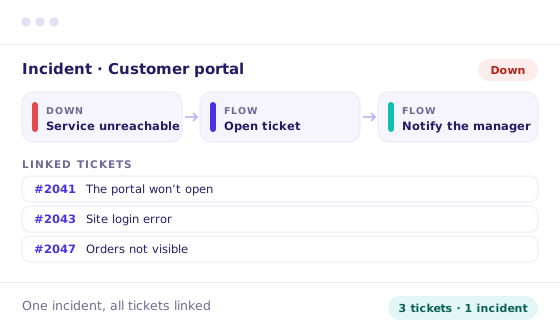
One incident, all linked tickets
Link tickets to the incident that caused them and go from the ticket to the affected service. With Flow you can open a ticket or notify a manager when a service goes Down.
Tickets linked to the incident
Service visible from the ticket
Automations with Flow
One incident to manage
Status for customers
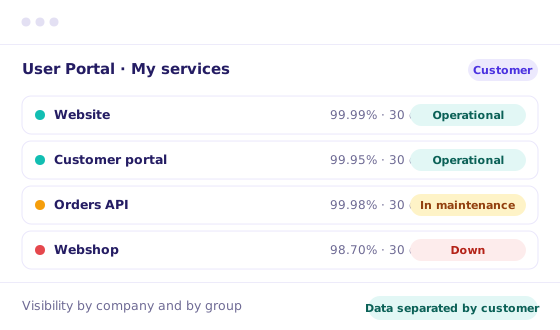
Customers check their services’ status on their own
Customers see the status and availability of their services from the User Portal, without calling support. You choose what to show and to whom. MSPs manage multiple customers from a single instance.
Status in the User Portal
Visibility by group
Multiple customers, separate data
More transparency
Discover the full platform, no commitment
Uptime in detail
SSL/TLS expiry under control
For HTTPS services, Uptime detects and stores the SSL/TLS certificate expiry date on the monitor, so you can plan the renewal ahead.
Every incident, logged automatically
When the incident is confirmed, the status changes to Down and Deepser opens a record, which is closed on recovery. The start is the first failed check, not the confirmation.
Monitoring and tickets on the same platform
Uptime works alongside Ticket Management: fewer separate tools and a fuller view before and during an incident.
The Uptime module is included in the license:
Starter
Plus
Enterprise
Simple pricing plans that meet your needs
We offer different packages starting from three operator seats. Bigger teams unlock larger discounts.
AI STUDIO
Get more value from the tools you already use
Connect Deepser to your existing technology stack and expand the platform’s capabilities without replacing what already works.





What Deepser offers
Low-code platform
Allows you to configure and customize processes quickly, ensuring autonomy even without technical development.
Intelligent Workflows
Support activities in real time by analyzing data and updates to trigger decisions within workflows.
Multi-LLM
Combines different language models to deliver effective responses based on diverse operational needs.
Verified on security, awarded on support
Every day we handle sensitive data, credentials, access and company information. Protecting it doesn't rely only on internal procedures, but on certified standards.

ISO 27001

ISO 9001

GDPR

MOST RECOMMENDED

4.6 ON CAPTERRA
Frequently asked questions about Uptime
What is Deepser Uptime?
Uptime is the Deepser module that automatically checks the availability of websites, portals, applications and APIs. It runs regular checks, logs incidents, measures how long they last and links them to tickets.
How often are checks run?
Checks run over HTTP or HTTPS at a configurable frequency, with a minimum interval of one minute. For each monitor you also define how many consecutive checks must fail before the incident is confirmed.
How is availability calculated?
Uptime calculates availability over three periods: 24 hours, 30 days and one year. Planned maintenance windows are excluded, so the figures reflect real downtime.
Can customers see the status of their services?
Yes. From the User Portal customers see the status and availability of their services without contacting support. You choose which monitors to show and to which user groups, based on company associations and permissions.
Is Uptime useful for MSPs too?
Yes. A Managed Service Provider can monitor the services of multiple customers from a single Deepser instance, keeping each customer’s data separate.
How do I activate Uptime?
Uptime is included in the Deepser Plus license. If you are already a customer, contact support to activate it. If not, request a demo from the sales team.